As AI absorbs the implementation layer of software engineering, the most valuable engineers will be those who can frame problems precisely, define what not to build, and exercise system-level judgement.
Somewhere in your organisation right now, a junior engineer is outshipping a senior engineer. Not because they’re more talented. Not because they’re working harder. But because they’ve stopped thinking of AI as a tool and started thinking of it as a collaborator — and the senior engineer hasn’t made that mental move yet.
AI is changing where the hard work of engineering actually happens. The question is whether your best people are moving with it.
The Paradigm Shift Nobody Named Correctly
For three decades, software engineering was fundamentally about translation. A human understood a problem, and a human translated that understanding into machine instructions. The quality of that translation was what distinguished good engineers from great ones.
That translation layer is now being automated. Not perfectly, not universally. But meaningfully. AI systems can now take a well-expressed intent and produce working, integrated, deployable code with a fidelity that would have seemed like science fiction five years ago.
The shift isn’t from “writing code” to “not writing code.” It’s from translation as the primary skill to intent expression as the primary skill. Engineers who thrive in this environment aren’t the ones who’ve abandoned technical depth. They’re the ones who’ve developed a second fluency: the ability to articulate desired outcomes with enough precision, context, and constraint that AI can execute reliably.
The key distinction: Intent expression isn’t prompting. It’s a mixture of requirements engineering, architecture, and system thinking compressed into a new kind of communication.
What This Does to DevOps — and Who’s Left Standing Where
Look at any modern DevOps pipeline: requirements, design, implementation, testing, integration, deployment, monitoring. For the last twenty years, the human effort has been distributed across all of those stages, with the heaviest concentration in the middle — implementation and integration.
AI is hollowing out that middle. Implementation cycles that took weeks now take days. Boilerplate that consumed senior engineering time is generated in minutes. Integration tasks that required deep contextual knowledge are increasingly handled by AI systems that can hold the full codebase in context simultaneously.
The human touch points aren’t disappearing. They’re concentrating. At the front — in problem framing, constraint definition, and architecture decisions — and at the back, in review, judgment, and the increasingly critical work of deciding what not to build.
This changes team structures in ways most organisations haven’t caught up to. The ratio of senior to junior engineers needs to be rethought. The kinds of feedback that produce growth in a junior engineer are different when their daily work is less about syntax and more about specification.
The Career Identity Crisis You’re Not Talking About
Here’s the thing nobody in leadership wants to say out loud: a significant number of your senior engineers built their professional identity around craft and keyboard output. The respect earned through hard-won mastery of a language.
That identity isn’t just a feeling. It’s embedded in your performance frameworks, your promotion criteria, your hiring rubrics, and the cultural story your engineering organisation tells about what it values.
When the highest-leverage contributions are in the problem framing meeting rather than the IDE — engineers who’ve optimised for the old signal can feel genuinely displaced. Not because they lack ability, but because the work has moved away from the place where they’ve learned to demonstrate it.
The engineers who adapt fastest tend to be more interested in the problem than the solution. They asked “why are we building this?” before diving in. They pushed back on requirements. That disposition — which looked like stubbornness in the old model — is exactly the right instinct for the new one.
The Skills Pyramid Has Inverted
Think about how engineering skill has traditionally been valued. At the base: broad programming fundamentals. Rising toward the apex: increasingly rare, increasingly valued capabilities — deep systems knowledge, architectural judgment, technical leadership. The pyramid was steep because each layer required the one below it, and very few engineers made it to the top.
AI is reshaping that pyramid. Not by eliminating any tier, but by changing the relative scarcity — and therefore the relative value — of what sits at each level.
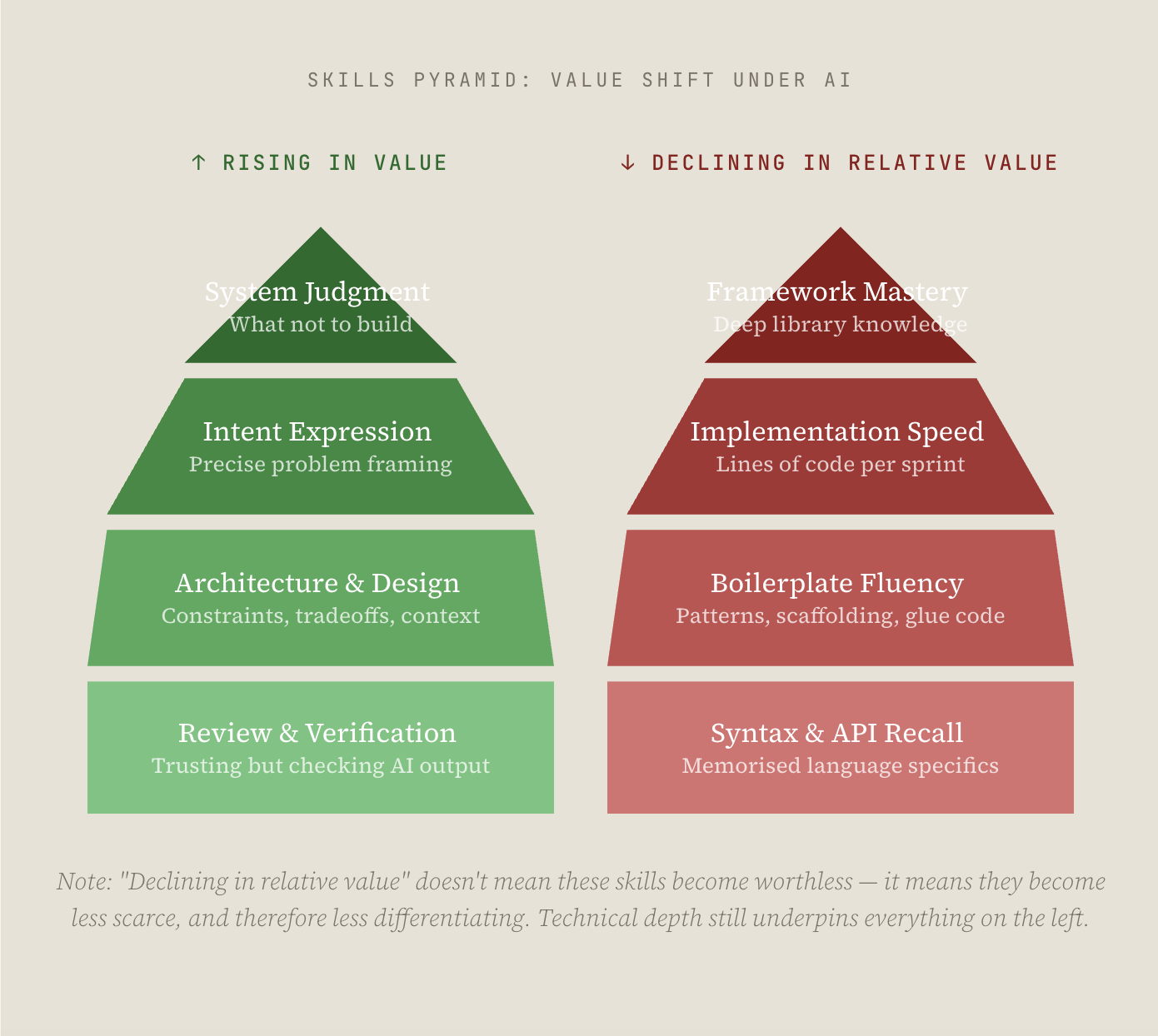
The right-hand column isn’t a list of skills you should stop developing. It’s a list of skills you should stop using as primary proxies for seniority. Syntax recall was never really what made someone senior — it was just the most visible part of a much deeper capability set.
What “Senior” Has to Mean Now
Seniority in engineering has always been somewhat opaque. We know it when we see it — the engineer who asks the right question in the architecture review, who spots the flaw in the product requirement before a line of code is written, who knows which technical debt to pay down and which to carry. But our formal criteria have often measured something more legible: years of experience, breadth of technologies, volume of contributions.
AI is forcing a reckoning with that gap.
Here’s what senior engineering capability looks like in this environment:
Problem decomposition under uncertainty. Can you take an ambiguous goal and break it into verifiable, AI-executable sub-problems?
Constraint articulation. The difference between a good AI-assisted engineering outcome and a bad one is often the quality of the constraints provided upfront. Non-functional requirements. Regulatory considerations. Operational limits. Compatibility constraints.
Judgment about what to verify. When AI produces output at high speed, the bottleneck moves to review and verification. Senior engineers need a strong intuition for where AI-generated code is likely to fail — subtle security issues, edge cases in business logic, performance characteristics under load. This is deeply technical work. It just looks different from before.
The courage to not build. This has always been the rarest skill in software. It requires enough understanding of the full stack — technical, product, organisational — to recognise when a problem is better solved by removing something than adding something.
What This Means for How You Lead
If you manage or lead technical teams, this shift creates three immediate responsibilities — not somewhere in the future, but in your next performance cycle, your next hiring decision, your next team design conversation.
Update your seniority criteria, explicitly. If your promotion framework still primarily rewards output velocity and breadth of technical contribution, you’re measuring the wrong things — and you’re signalling to your best people that the wrong things matter. This doesn’t mean rewriting everything from scratch. It means explicitly adding criteria for problem framing, architectural judgment, and technical risk identification, and making clear these are upstream of implementation in the value chain.
Create space for upstream work. The cognitive work of framing problems well is slow, iterative, and hard to make visible. In organisations optimised for delivery velocity, it tends to get squeezed out.
Talk to your seniors directly about the shift. The identity displacement is real, and it’s uncomfortable. The engineers who need this conversation most are often the ones least likely to ask for it, because they’ve built professional confidence on certainty about what good work looks like.
The leadership test: Ask yourself: in your last five promotion decisions, how much weight did you give to the quality of someone’s questions versus the quality of their code? If the ratio doesn’t reflect where value is moving, your incentive structure is working against you.
The Craft Isn’t Dead — It’s Moved
The craft of engineering — the deep understanding of systems, the rigorous thinking about tradeoffs, the hard-earned intuition about where things fail — is more important than it has ever been. AI does not reduce the value of that knowledge. It changes the medium through which that knowledge is expressed and applied.
What’s dying is the conflation of craft with its most visible output. The lines of code and the framework expertise. Those were always proxies for something deeper.
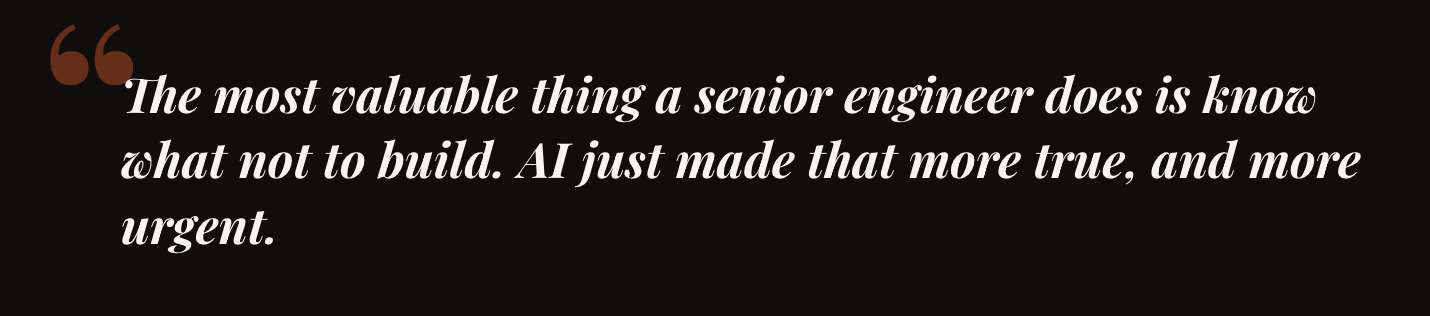
“The most valuable thing a senior engineer does is know what not to build. AI just made that more true, and more urgent.”
The engineers who understand that are already operating in the model that the rest of the industry is only just beginning to see. The question for technical leaders is simple, and it isn’t about AI at all:
Are you making it easier or harder for those engineers to do their best work?
